Your Practice Runs on You. Here Is What a System Takes Off Your Plate
What we actually build, piece by piece, and how to work out the hours and the clients it gives you back.
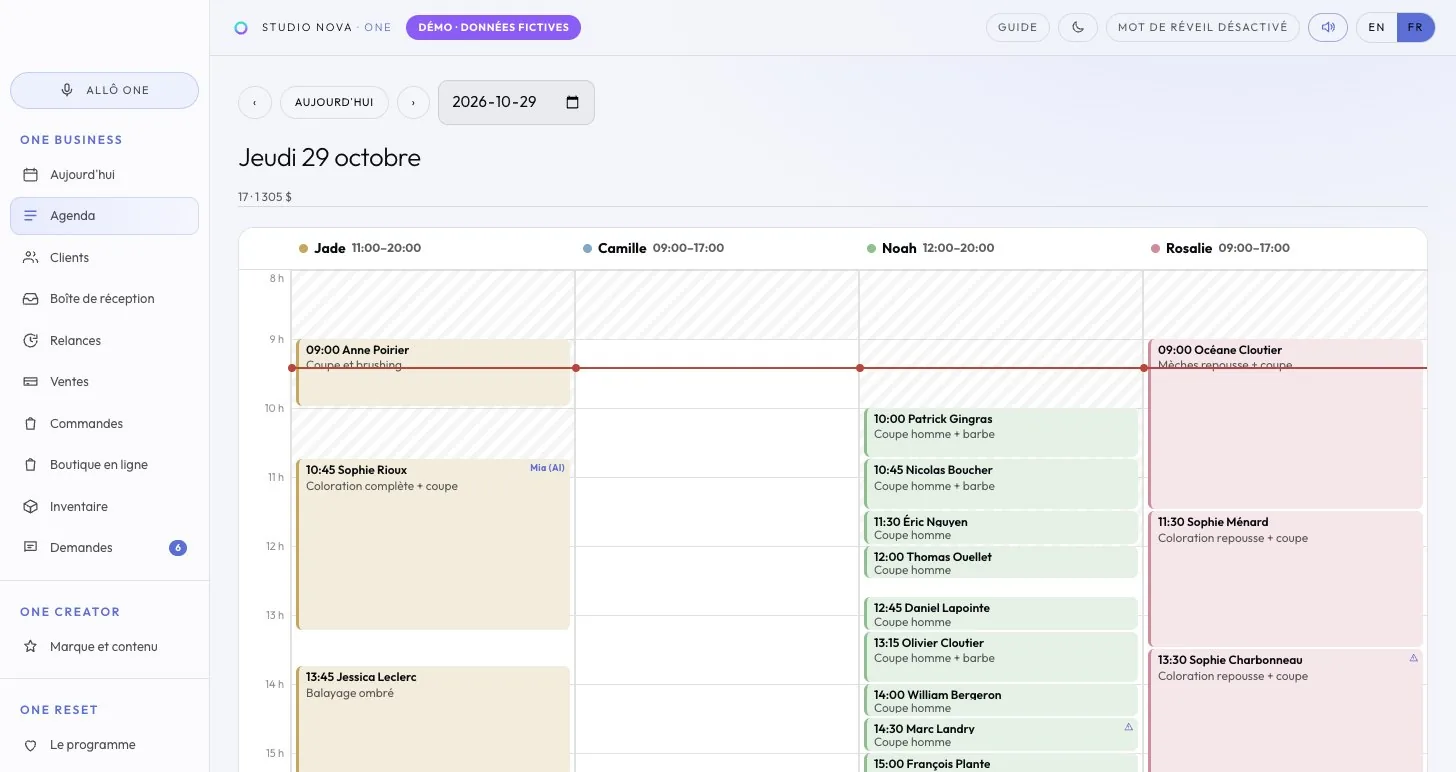
It's 7:40 p.m. Your last client left an hour ago and you're still at the desk. Three voicemails, two from numbers you don't know. A booking request on Instagram from yesterday that you haven't answered. A client who wrote to move Thursday, and you're not sure you replied. You open the booking app, then the email app, then the texting app, then the spreadsheet where you track who you should follow up with, and none of them know what the others are doing.
You're good at what you do. Your clients tell you so. But every call, every reminder, every follow-up and every post goes through you, so your income stops where your hours stop. And the evenings that were supposed to be for your family go to the business side of the business.
I know that desk. I sat at it for years.
How I learned this the hard way
From 2017 to 2021 I ran Biologik Health, an online stress and energy program, on my own. Before there was any online machine, I was handing out flyers in downtown Montreal and meeting one-on-one clients in shared offices, because I didn't have an office of my own. Later the program grew: more than three hundred people followed it, and the Facebook group behind it grew to nearly 10,000 members. At its best it brought in about $10,000 a month.
It was also chaos. I had so many tools to make work together, so many subscriptions. My email list alone cost me $500 a month, because I had 25,000 contacts on it. I answered the calls, wrote the content, made sure the strategy held, and ran the online store by hand. No automations. I spent most of my time on the phone, and I still missed a lot of calls, because there was simply too much to manage. I didn't have time to follow up with every client, every email, every person in the group. My content suffered for it. And it was lonely, because there was nobody else.
That's why OneOS exists. I built it for myself first: the system I needed back then.
Why it keeps happening
The business side of most practices was never built. It was improvised, one app at a time, each one bought to fix one problem. Booking here, texting there, a newsletter tool, a course platform, a spreadsheet for follow-ups. Each one works. None of them talk to each other. So something has to connect them, and that something is you.
You are the integration. Every time a client books, cancels, pays, asks a question or goes quiet, you're the one carrying the information from one tool to the next. That's the work that eats your evenings, and it's the work a system should do.
What we build, piece by piece
One Business is one system that carries the business side of your practice. Here is what's in it, what each piece does, and why it matters.
1. Your One: one screen for the whole business. Your console carries your business name. Every morning it tells you who's coming in, what came in overnight, what's waiting for you and what's coming up. Why: you start the day knowing where you stand, instead of finding out as it happens.
2. Online booking and automatic reminders. Clients book themselves from your site or a link. They get a confirmation by email and a text the day before. Why: no more back-and-forth to find a time, and most no-shows are simply people who forgot.
3. Client files and follow-ups in one place. Every client on one record: their bookings, their purchases, your care notes, your emails. The follow-up list tells you who to call back, at which stage, and when. Why: you stop digging through your phone, and nobody falls through the cracks because you were busy.
4. One inbox, and a text back after a missed call. Calls, texts, emails and forms land in the same place. When you miss a call because you're with a client, the person gets a text back right away. Why: the person who calls you and hears nothing usually calls someone else. This is the piece I needed most at Biologik.
5. Mia, who answers when you can't. Mia is the receptionist of your AI team. She answers your phone and your emails, in English and in French, answers questions about your services, books the appointment in your calendar, and hands off to you when it matters. She says she's an AI. And nothing goes out in your name without your yes. Why: you take care of the client in front of you, and the next one still gets an answer.
6. Your program, in the same place. When you're ready to get out of one-on-one, your online course and a member area for your clients live inside the same system as your bookings and your follow-ups. Why: the client who buys your program is the same person who booked a session last year, and you see the whole story on one record.
7. Run it by voice, too. "Who's coming in tomorrow?" "Follow up with Julie on Thursday." You say it, it does it. Why: the fastest way to get something off your mind is to say it out loud, between two clients.
8. Learning to bring AI into your practice. Our lessons show you, step by step, how to use AI in your own practice, so it stops being a buzzword and starts saving you hours. Why: the tools will keep changing. Knowing how to use them stays.
Do it yourself, with us, or for you
You choose how far we go together. All three plans are on the OneOS Success System page.
- OneOS Core, $97 a month (or $970 a year). Your One with booking, reminders, client files and your morning summary, our lessons, and group coaching. You build it yourself, and you're not alone doing it.
- OneOS+, $197 a month (or $1,970 a year). Everything in Core, plus Mia, Mark and Fina, the automations (every request becomes a tracked lead, emails that bring clients back, review requests), one inbox, and your online courses and member area. On the yearly plan: your website, your brand guide and a short 30-day strategy.
- One Partner, by application. We build it for you, custom, and we stay. The details are on the plans page.
The numbers: your worksheet
Prices are public, so you should be able to work out what this is worth to you before you talk to anyone. Here are the four lines. Use your own numbers.
1. The calls you miss. Calls a week × 4.33 × the share you miss × the share of those who were new clients × what a client is worth to you over a year.
2. The hours you spend on admin. Hours a week on booking, reminders, follow-ups and the inbox × what one hour of your time is worth.
3. The software you stop paying for. List what you pay today: booking, texting, email, course platform, website, follow-up tool. Add it up. (Mine was $500 a month for email alone.)
4. Minus the plan. $97 or $197 a month.
An example, with made-up numbers. Sam is a practitioner. A session is $120, and a typical client comes back 6 times a year, so a client is worth $720 a year. Sam gets 20 calls a week and misses a quarter of them, about 22 a month. If 1 in 5 of those was a new client, that's about 4 new clients a month who called someone else: $2,880 of yearly business walking away every month. Sam also spends 6 hours a week on admin. Even valued at half the session rate, $60 an hour, that's about $1,560 a month. Put that next to $197.
Your numbers will be different. That's the point: do them. Our calculator does it in a minute.
We don't promise a result. We measure it with you: at day 90, we look at the hours you got back, the calls that were answered and the clients who came back, together.
What it looks like when it holds
Tuesday, 6 p.m. You close on time. The calls that came in during your sessions were answered, and the people who wanted to book are booked. The client who went quiet three months ago got a note and booked again. You know what tomorrow looks like before it starts. And when you're ready to launch your program, the system that carries it is already running.
This is the first pillar of OneOS Success System. The second is One Creator: the brand and the content that bring the right people to the business you just made easier to run. The third is One Reset: the person carrying it all.
If this is your desk at 7:40 p.m., book the audit. Thirty minutes: we look at your practice, the technical side and the human side, and show you where it's stuck.
Max
P.S. Not ready to talk yet? The Circuit is our free community: a live session with me every week, and other owners living what you live.
Your Practice Runs on You. Here Is What a System Takes Off Your Plate
What we actually build, piece by piece, and how to work out the hours and the clients it gives you back.
It's 7:40 p.m. Your last client left an hour ago and you're still at the desk. Three voicemails, two from numbers you don't know. A booking request on Instagram from yesterday that you haven't answered. A client who wrote to move Thursday, and you're not sure you replied. You open the booking app, then the email app, then the texting app, then the spreadsheet where you track who you should follow up with, and none of them know what the others are doing.
You're good at what you do. Your clients tell you so. But every call, every reminder, every follow-up and every post goes through you, so your income stops where your hours stop. And the evenings that were supposed to be for your family go to the business side of the business.
I know that desk. I sat at it for years.
How I learned this the hard way
From 2017 to 2021 I ran Biologik Health, an online stress and energy program, on my own. Before there was any online machine, I was handing out flyers in downtown Montreal and meeting one-on-one clients in shared offices, because I didn't have an office of my own. Later the program grew: more than three hundred people followed it, and the Facebook group behind it grew to nearly 10,000 members. At its best it brought in about $10,000 a month.
It was also chaos. I had so many tools to make work together, so many subscriptions. My email list alone cost me $500 a month, because I had 25,000 contacts on it. I answered the calls, wrote the content, made sure the strategy held, and ran the online store by hand. No automations. I spent most of my time on the phone, and I still missed a lot of calls, because there was simply too much to manage. I didn't have time to follow up with every client, every email, every person in the group. My content suffered for it. And it was lonely, because there was nobody else.
That's why OneOS exists. I built it for myself first: the system I needed back then.
Why it keeps happening
The business side of most practices was never built. It was improvised, one app at a time, each one bought to fix one problem. Booking here, texting there, a newsletter tool, a course platform, a spreadsheet for follow-ups. Each one works. None of them talk to each other. So something has to connect them, and that something is you.
You are the integration. Every time a client books, cancels, pays, asks a question or goes quiet, you're the one carrying the information from one tool to the next. That's the work that eats your evenings, and it's the work a system should do.
What we build, piece by piece
One Business is one system that carries the business side of your practice. Here is what's in it, what each piece does, and why it matters.
1. Your One: one screen for the whole business. Your console carries your business name. Every morning it tells you who's coming in, what came in overnight, what's waiting for you and what's coming up. Why: you start the day knowing where you stand, instead of finding out as it happens.
2. Online booking and automatic reminders. Clients book themselves from your site or a link. They get a confirmation by email and a text the day before. Why: no more back-and-forth to find a time, and most no-shows are simply people who forgot.
3. Client files and follow-ups in one place. Every client on one record: their bookings, their purchases, your care notes, your emails. The follow-up list tells you who to call back, at which stage, and when. Why: you stop digging through your phone, and nobody falls through the cracks because you were busy.
4. One inbox, and a text back after a missed call. Calls, texts, emails and forms land in the same place. When you miss a call because you're with a client, the person gets a text back right away. Why: the person who calls you and hears nothing usually calls someone else. This is the piece I needed most at Biologik.
5. Mia, who answers when you can't. Mia is the receptionist of your AI team. She answers your phone and your emails, in English and in French, answers questions about your services, books the appointment in your calendar, and hands off to you when it matters. She says she's an AI. And nothing goes out in your name without your yes. Why: you take care of the client in front of you, and the next one still gets an answer.
6. Your program, in the same place. When you're ready to get out of one-on-one, your online course and a member area for your clients live inside the same system as your bookings and your follow-ups. Why: the client who buys your program is the same person who booked a session last year, and you see the whole story on one record.
7. Run it by voice, too. "Who's coming in tomorrow?" "Follow up with Julie on Thursday." You say it, it does it. Why: the fastest way to get something off your mind is to say it out loud, between two clients.
8. Learning to bring AI into your practice. Our lessons show you, step by step, how to use AI in your own practice, so it stops being a buzzword and starts saving you hours. Why: the tools will keep changing. Knowing how to use them stays.
Do it yourself, with us, or for you
You choose how far we go together. All three plans are on the OneOS Success System page.
- OneOS Core, $97 a month (or $970 a year). Your One with booking, reminders, client files and your morning summary, our lessons, and group coaching. You build it yourself, and you're not alone doing it.
- OneOS+, $197 a month (or $1,970 a year). Everything in Core, plus Mia, Mark and Fina, the automations (every request becomes a tracked lead, emails that bring clients back, review requests), one inbox, and your online courses and member area. On the yearly plan: your website, your brand guide and a short 30-day strategy.
- One Partner, by application. We build it for you, custom, and we stay. The details are on the plans page.
The numbers: your worksheet
Prices are public, so you should be able to work out what this is worth to you before you talk to anyone. Here are the four lines. Use your own numbers.
1. The calls you miss. Calls a week × 4.33 × the share you miss × the share of those who were new clients × what a client is worth to you over a year.
2. The hours you spend on admin. Hours a week on booking, reminders, follow-ups and the inbox × what one hour of your time is worth.
3. The software you stop paying for. List what you pay today: booking, texting, email, course platform, website, follow-up tool. Add it up. (Mine was $500 a month for email alone.)
4. Minus the plan. $97 or $197 a month.
An example, with made-up numbers. Sam is a practitioner. A session is $120, and a typical client comes back 6 times a year, so a client is worth $720 a year. Sam gets 20 calls a week and misses a quarter of them, about 22 a month. If 1 in 5 of those was a new client, that's about 4 new clients a month who called someone else: $2,880 of yearly business walking away every month. Sam also spends 6 hours a week on admin. Even valued at half the session rate, $60 an hour, that's about $1,560 a month. Put that next to $197.
Your numbers will be different. That's the point: do them. Our calculator does it in a minute.
We don't promise a result. We measure it with you: at day 90, we look at the hours you got back, the calls that were answered and the clients who came back, together.
What it looks like when it holds
Tuesday, 6 p.m. You close on time. The calls that came in during your sessions were answered, and the people who wanted to book are booked. The client who went quiet three months ago got a note and booked again. You know what tomorrow looks like before it starts. And when you're ready to launch your program, the system that carries it is already running.
This is the first pillar of OneOS Success System. The second is One Creator: the brand and the content that bring the right people to the business you just made easier to run. The third is One Reset: the person carrying it all.
If this is your desk at 7:40 p.m., book the audit. Thirty minutes: we look at your practice, the technical side and the human side, and show you where it's stuck.
Max
P.S. Not ready to talk yet? The Circuit is our free community: a live session with me every week, and other owners living what you live.