The Transformation Is in the Transaction
Why good practitioners struggle to sell a $3,000 program, and what changes when you see where that comes from.
The sales page for your program is ready. The post that announces it has been sitting in your drafts for three weeks. On a call last Tuesday, someone asked what it costs, and before they could even react, you heard yourself offering a discount. Afterwards you told yourself you were being kind. But something in you knew that wasn't the whole story.
You've helped people for years. You know your field better than most. And yet the moment money enters the conversation, something tightens. Asking someone to pay feels like taking something from them, and you got into this work to give.
If that sounds familiar, there's a script running underneath it, one you never chose, and it plays every time you name your price.
Being good at your work doesn't make you good at selling it
This is the part nobody tells you when you train in health and wellness. Being a specialist in your field doesn't make you a good seller, and it certainly doesn't make you able to sell yourself. Those are different skills, and the second one runs into everything you believe about money, about worth and about who gets to charge for help.
In health and wellness it's even harder, because you want to help people. Charging feels like it contradicts that. So you lower the price, give the extra session, skip the follow-up because you don't want to be pushy, and keep the program in your drafts.
Here is what I had to understand: the transformation is in the transaction. The money is where the client's transformation begins. When someone pays for your program, they've decided. They show up differently, they do the work, they get the result. When you discount before they ask, you're not protecting them. You're taking that decision away from them.
Why me, and not someone famous?
Then there's the voice that shows up the day you decide to start something: why me? Why would anyone buy from me instead of Tony Robbins, or whoever is at the top of my field?
Here is the answer I found. There will always be someone who needs your help and who is a few steps behind where you are now. They don't need a celebrity. They need someone who walked the road a little ahead of them, who speaks their language and who answers their message. You don't need to be a multi-million-dollar name to change someone's life. You need to be one step ahead, and willing to say so.
I'm a certified naturopath. When I started, I handed out flyers in downtown Montreal and met clients in shared offices because I didn't have one of my own. Years later, Biologik Health had more than three hundred people in its program and a Facebook group of nearly 10,000. Nothing about my knowledge changed between those two moments. What changed was what I believed I was allowed to ask for.
Where it leaks: four places
One Reset works on the human side of the business with the same logic as the rest of OneOS. A system is parts that talk to each other. In One Business, we fix the leaks between your tools. In One Reset, we fix the leaks in what you tell yourself and in what you tell your team. Here are the four we see most.
1. Imposter syndrome, when you start or go online. It sounds like: "Who am I to do this?" It costs you: the post that stays in drafts, the program that never launches, the months you wait until you feel ready.
2. The discomfort of selling. It sounds like: "I don't want to be pushy." It costs you: the discount you give before anyone asks, the follow-up you never send, the person who wanted to buy and never got asked.
3. Money and worth. It sounds like: "Even after a good week, a little voice finds what's missing." It costs you: prices you haven't raised in years, the feeling that it's never enough, no matter what comes in.
4. What you tell your team. It sounds like: "It's faster if I do it myself." It costs you: everything goes through you, your best people wait, then leave, and the truth stops reaching you.
How we work on it
One Reset starts with seeing where these beliefs come from. That was the turning point for me: with the One Reset tools, I understood where my limiting beliefs came from, and I saw that a money block is a real problem when you want to run a business. A belief like that was learned, which means it can be rewritten.
Underneath that is something bigger: understanding how reality responds to what you carry inside, and how getting what you want actually works. Call it manifestation, call it what you will. The One Reset tools are there to make it practical, every morning and every evening.
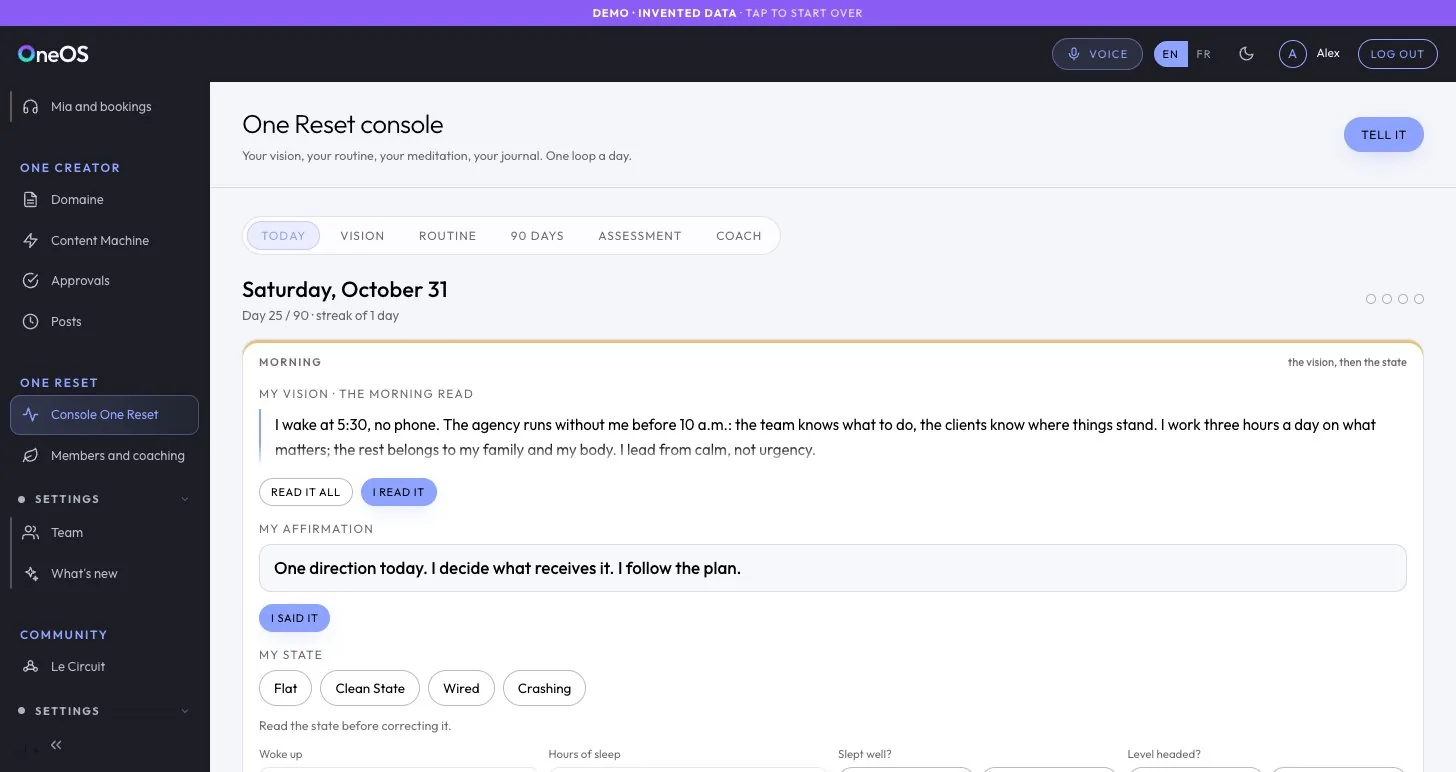
- The 28 days. A 28-day path, four weeks, a 3-minute check-in morning and night, and coaching every week, online, in English or in French. You start from stillness, see yourself clearly, rewrite what you tell yourself about money, worth and showing up, then work on what you tell each other as a team.
- For your team. The same work, done together, so the way you talk to each other on Monday morning stops setting the mood for the whole week.
- How to get it. The 28 days come with One Partner. For One Reset alone, or for your team, book a call. OneOS Core includes the One Reset lessons and a weekly One Reset group coaching, starting soon. The plans are on the OneOS Success System page.
The numbers: what a belief costs you
The inside part has no price tag. The outside part does, and it's worth doing the math once. Use your own numbers.
1. The discount you give before anyone asks. The average discount × the number of clients a year who get it.
2. The price you haven't raised. The gap between your price and the price you know your work is worth × your sales in a year.
3. The program still in your drafts. The number of months you've delayed it × the sales you expected per month.
4. The good person who leaves. What it costs to find, hire and train someone new, plus the clients who leave with them.
An example, with made-up numbers. Alex is a coach with a group program at $2,500. Alex gives $300 off to about half of the 20 people who join each year: $3,000. The program launch has been delayed five months, and Alex expected to sell two a month: ten sales, $25,000, still in the drafts. Alex's skill was never the problem.
We don't promise a number. What we measure, with you, is what changes on the outside: the price you say out loud, the post that goes out, the program that launches.
What it looks like when it holds
You say the price and you stop talking. You let the other person decide. The post goes out on the day you planned. Your team brings you the problem on Monday instead of hiding it until Friday. And the voice that asked "who am I to do this?" gets quieter, because you have an answer now.
This is the third pillar of OneOS Success System. The first is One Business, the system that carries your practice. The second is One Creator, the brand and content that bring the right people to you. None of it holds if the person at the top doesn't.
If you recognized yourself in this, book the audit. Thirty minutes: we look at your business, the technical side and the human side, and show you where it's stuck.
Max
P.S. Not ready to talk yet? The Circuit is our free community: a live session with me every week, and other owners living what you live.
The Transformation Is in the Transaction
Why good practitioners struggle to sell a $3,000 program, and what changes when you see where that comes from.
The sales page for your program is ready. The post that announces it has been sitting in your drafts for three weeks. On a call last Tuesday, someone asked what it costs, and before they could even react, you heard yourself offering a discount. Afterwards you told yourself you were being kind. But something in you knew that wasn't the whole story.
You've helped people for years. You know your field better than most. And yet the moment money enters the conversation, something tightens. Asking someone to pay feels like taking something from them, and you got into this work to give.
If that sounds familiar, there's a script running underneath it, one you never chose, and it plays every time you name your price.
Being good at your work doesn't make you good at selling it
This is the part nobody tells you when you train in health and wellness. Being a specialist in your field doesn't make you a good seller, and it certainly doesn't make you able to sell yourself. Those are different skills, and the second one runs into everything you believe about money, about worth and about who gets to charge for help.
In health and wellness it's even harder, because you want to help people. Charging feels like it contradicts that. So you lower the price, give the extra session, skip the follow-up because you don't want to be pushy, and keep the program in your drafts.
Here is what I had to understand: the transformation is in the transaction. The money is where the client's transformation begins. When someone pays for your program, they've decided. They show up differently, they do the work, they get the result. When you discount before they ask, you're not protecting them. You're taking that decision away from them.
Why me, and not someone famous?
Then there's the voice that shows up the day you decide to start something: why me? Why would anyone buy from me instead of Tony Robbins, or whoever is at the top of my field?
Here is the answer I found. There will always be someone who needs your help and who is a few steps behind where you are now. They don't need a celebrity. They need someone who walked the road a little ahead of them, who speaks their language and who answers their message. You don't need to be a multi-million-dollar name to change someone's life. You need to be one step ahead, and willing to say so.
I'm a certified naturopath. When I started, I handed out flyers in downtown Montreal and met clients in shared offices because I didn't have one of my own. Years later, Biologik Health had more than three hundred people in its program and a Facebook group of nearly 10,000. Nothing about my knowledge changed between those two moments. What changed was what I believed I was allowed to ask for.
Where it leaks: four places
One Reset works on the human side of the business with the same logic as the rest of OneOS. A system is parts that talk to each other. In One Business, we fix the leaks between your tools. In One Reset, we fix the leaks in what you tell yourself and in what you tell your team. Here are the four we see most.
1. Imposter syndrome, when you start or go online. It sounds like: "Who am I to do this?" It costs you: the post that stays in drafts, the program that never launches, the months you wait until you feel ready.
2. The discomfort of selling. It sounds like: "I don't want to be pushy." It costs you: the discount you give before anyone asks, the follow-up you never send, the person who wanted to buy and never got asked.
3. Money and worth. It sounds like: "Even after a good week, a little voice finds what's missing." It costs you: prices you haven't raised in years, the feeling that it's never enough, no matter what comes in.
4. What you tell your team. It sounds like: "It's faster if I do it myself." It costs you: everything goes through you, your best people wait, then leave, and the truth stops reaching you.
How we work on it
One Reset starts with seeing where these beliefs come from. That was the turning point for me: with the One Reset tools, I understood where my limiting beliefs came from, and I saw that a money block is a real problem when you want to run a business. A belief like that was learned, which means it can be rewritten.
Underneath that is something bigger: understanding how reality responds to what you carry inside, and how getting what you want actually works. Call it manifestation, call it what you will. The One Reset tools are there to make it practical, every morning and every evening.
- The 28 days. A 28-day path, four weeks, a 3-minute check-in morning and night, and coaching every week, online, in English or in French. You start from stillness, see yourself clearly, rewrite what you tell yourself about money, worth and showing up, then work on what you tell each other as a team.
- For your team. The same work, done together, so the way you talk to each other on Monday morning stops setting the mood for the whole week.
- How to get it. The 28 days come with One Partner. For One Reset alone, or for your team, book a call. OneOS Core includes the One Reset lessons and a weekly One Reset group coaching, starting soon. The plans are on the OneOS Success System page.
The numbers: what a belief costs you
The inside part has no price tag. The outside part does, and it's worth doing the math once. Use your own numbers.
1. The discount you give before anyone asks. The average discount × the number of clients a year who get it.
2. The price you haven't raised. The gap between your price and the price you know your work is worth × your sales in a year.
3. The program still in your drafts. The number of months you've delayed it × the sales you expected per month.
4. The good person who leaves. What it costs to find, hire and train someone new, plus the clients who leave with them.
An example, with made-up numbers. Alex is a coach with a group program at $2,500. Alex gives $300 off to about half of the 20 people who join each year: $3,000. The program launch has been delayed five months, and Alex expected to sell two a month: ten sales, $25,000, still in the drafts. Alex's skill was never the problem.
We don't promise a number. What we measure, with you, is what changes on the outside: the price you say out loud, the post that goes out, the program that launches.
What it looks like when it holds
You say the price and you stop talking. You let the other person decide. The post goes out on the day you planned. Your team brings you the problem on Monday instead of hiding it until Friday. And the voice that asked "who am I to do this?" gets quieter, because you have an answer now.
This is the third pillar of OneOS Success System. The first is One Business, the system that carries your practice. The second is One Creator, the brand and content that bring the right people to you. None of it holds if the person at the top doesn't.
If you recognized yourself in this, book the audit. Thirty minutes: we look at your business, the technical side and the human side, and show you where it's stuck.
Max
P.S. Not ready to talk yet? The Circuit is our free community: a live session with me every week, and other owners living what you live.